
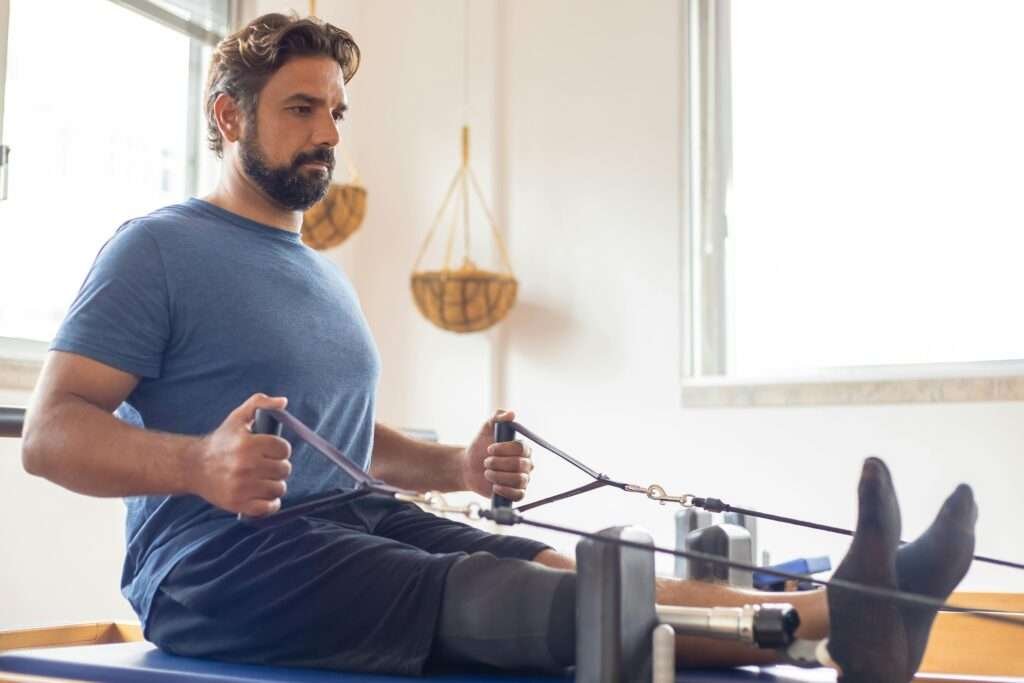
How physical therapy, occupational therapy, chiropractic care, and pain management can address work-related physical ailments and support sustainable recovery. Written for patrol officers, dispatch and civilian personnel, and department leaders.
Police work can demand a sudden sprint after hours in a vehicle, a forceful restraint, repeated lifting, or a long shift at a dispatch console. Pain and injury can affect much more than attendance: driving, concentration, grip, endurance, sleep, and family activities may all become harder. Rehabilitation should address the person’s diagnosis and the actual demands of the job.
Coordinated care can help restore function and manage persistent symptoms. The strongest justification is a shared plan with measurable goals—not automatically scheduling every employee with every provider. Evidence for individual treatments and multidisciplinary rehabilitation is broader than evidence for one specific four-service package in police departments.
Where the job can take a physical toll
A critical review of law-enforcement injuries identified sprains and strains as common injury types and upper-extremity injuries as prominent across the included studies. Encounters with non-compliant offenders were an important injury mechanism. Injury patterns differ by assignment, agency, and study methods.[1]
Common complaints and task exposures
- Neck and upper back: screen viewing and sustained positions
- Shoulder: forceful tasks and lifting
- Low back and hip: vehicle time and equipment discomfort
- Hand and wrist: gripping and repetitive tasks
- Knee and ankle: running, stairs and uneven ground
Clinical examples of body regions and task demands. A symptom location alone does not establish a diagnosis or work-related causation.
| Work exposure | Possible physical problem | Functional consequence to assess |
|---|---|---|
| Patrol driving and equipment pressure | Low-back or hip discomfort | Sitting tolerance, turning to check traffic, vehicle entry and exit |
| Restraints, defensive tactics and lifting | Shoulder, elbow or hand sprain or strain | Reach, grip, push, pull and safe equipment handling |
| Sprints, stairs and uneven terrain | Knee or ankle injury and tendon overload | Balance, walking, running and changes of direction |
| Dispatch, records and administrative work | Neck, shoulder or upper-limb symptoms | Keyboard tolerance, workstation use and sustained attention |
| Collision, fall or assault | Traumatic injury requiring medical assessment | Neurologic status, movement safety and need for restrictions |
Police-specific driving research links greater driving exposure with self-reported low-back trouble.[2] A later review highlights vehicle layout, worn equipment, and physical conditioning as areas for intervention, while noting that direct intervention research in officers remains limited.[3] These findings support individual ergonomic assessment; they do not establish that a particular belt, seat, or posture caused every case of pain.
Four services with distinct contributions
Physical therapy
PT evaluates movement, strength, balance, endurance, and symptom behavior. An individualized plan may include graded exercise, walking or aerobic conditioning, mobility work, and progressive practice of lifting, stairs, vehicle transfers, and other essential tasks. Learn more about physical therapy at Omega Physical Rehab.
The early aim is tolerable movement and restoration of basic function. Longer-term care builds capacity for job demands and a realistic home program. Exercise has evidence for chronic nonspecific low-back pain; results should not be assumed to apply equally to every injury.[4]
Occupational therapy
OT connects recovery to daily activities and work performance. Care may include hand and upper-limb rehabilitation, pacing, task adaptation, workstation assessment, and strategies for dressing, household activities, and returning to productive work. See our hand & occupational therapy services.
A systematic review found promising results for individually tailored OT supporting return to work in musculoskeletal conditions.[5] Upper-limb work-participation evidence remains insufficient to endorse one specific intervention for everyone.[6] Job-specific goals and reassessment matter.
Chiropractic care
For appropriately screened musculoskeletal problems, chiropractic care may include education, exercise, mobilization, or spinal manipulation. Manual care can be an option within a broader rehabilitation plan when it supports function. Learn more about chiropractic care at our clinics.
A 2026 Cochrane review found that spinal manipulative therapy may provide small pain and moderate functional benefits compared with sham treatment for chronic low-back pain. Adverse-event reporting was incomplete; temporary soreness or increased pain occurred.[7] Fracture, instability, progressive neurologic signs, and other contraindications require assessment before manipulation.
Pain management
A medical pain clinician can clarify persistent or complex symptoms, review medications, coordinate further evaluation, and consider procedures when justified by the diagnosis. Pain education and referral for behavioral pain care can support rehabilitation when fear, distress, or sleep disruption interferes with recovery. See our pain management services.
For chronic low-back pain, ACP guidance prioritizes nonpharmacologic approaches first.[8] Medication decisions require individual benefit-risk review, especially when sedation could affect driving or other safety-sensitive duties. Injections are not a universal treatment or a replacement for rebuilding function.
What does the research actually show
Exercise helps, but a meaningful pain improvement is not the same as full duty readiness. In a 2021 Cochrane review, average benefits versus no treatment, usual care, or placebo were larger for pain than for functional limitation at the earliest follow-up.[4]
- Pain: 15.2 points greater reduction on a 0–100 scale (95% CI 12.2–18.3), meeting the review’s 15-point clinical-importance threshold.
- Functional limitation: 6.8 points greater reduction (95% CI 5.3–8.3), below the review’s 10-point threshold.
Moderate-certainty evidence. These are pooled between-group differences, not percentage improvement, a before-and-after patient trajectory, or police-specific results.
Coordinated care has evidence—with boundaries.
A Cochrane-associated review found small average pain and disability benefits from multidisciplinary biopsychosocial rehabilitation for chronic low-back pain. At one year, odds of being at work were higher than with physical treatments alone (OR 1.87; 95% CI 1.39–2.53), but not clearly higher than usual care.[9] An odds ratio is not an 87% absolute increase. These programs combined physical care with psychological and/or social or work components; they were not a test of this exact PT–OT–chiropractic–pain management package.
How a shared recovery plan can work
One shared plan covers diagnosis, function, job demands, progress, restrictions and reassessment. Each service contributes where it is clinically needed:
- Physical therapy: movement and physical capacity
- Occupational therapy: activities and work performance
- Chiropractic care: selected musculoskeletal care
- Pain management: medical assessment and treatment
Not every employee needs all four services. Behavioral health, occupational medicine and specialists may also be needed.
1. Assess and protect. Identify the injury, screen for serious pathology, clarify work restrictions, and choose a lead clinician. Share relevant information among treating professionals with appropriate consent.
2. Restore everyday function. Select symptom-tolerable activity and measurable goals for walking, sitting, reaching, gripping, sleep-related function, and daily tasks. Avoid an arbitrary timetable that ignores tissue healing or surgical precautions.
3. Rebuild job capacity. Progress toward actual essential duties: stairs, vehicle transfers, repeated lifting, prolonged workstation use, or physical conditioning. Tactical simulations require clinical clearance and appropriate training supervision.
4. Sustain recovery. Reassess function, revise the home program, review equipment and task demands, and agree on how to respond to recurring symptoms. Formal duty clearance belongs with the authorized clinician and the department’s process.
Measure function as well as pain
| Track | Example of a useful measure |
|---|---|
| Symptoms and disability | Pain rating plus a condition-appropriate tool such as ODI, QuickDASH, or LEFS |
| Physical capacity | Grip strength, balance, walking endurance, or graded lifting tolerance |
| Work performance | Vehicle transfers, sitting duration, keyboard tolerance, and essential task completion |
| Sustainable participation | Work status, restricted-duty days, recurrent episodes, and function at follow-up |
Sample individualized goals might include tolerating a planned dispatch work interval with agreed breaks, completing repeated vehicle transfers safely, or meeting a defined lifting requirement without a sustained symptom flare. The starting level, target, and deadline should come from the examination and job analysis. Pain relief alone cannot establish readiness for unrestricted duty.
What departments and employees can do now
- Provide a clear route for early injury reporting and timely clinical assessment.
- Review vehicle and desk setups, equipment fit, and frequently repeated tasks with staff input. Any equipment change must preserve operational safety and agency requirements.
- Build practical opportunities for position changes and movement when duties allow.
- Offer graded conditioning and modified duties aligned with medical restrictions.
- Coordinate care rather than duplicating treatments, and evaluate outcomes over time.
These are practical applications of occupational rehabilitation principles, not a promise that any single workplace change prevents future disability. Long-term recovery depends on the diagnosis, injury severity, workload, access to care, and the employee’s response.
When rehabilitation should wait for medical evaluation
After significant trauma, suspected fracture, progressive weakness, new bowel or bladder dysfunction, saddle numbness, or severe symptoms with fever, seek prompt medical assessment. Chest pain, breathing difficulty, or new stroke-like symptoms require emergency care. Educational material cannot diagnose an injury or determine fitness for duty.
For law-enforcement and police department personnel, effective rehabilitation connects treatment to the activities that matter. A plan that rebuilds movement, adapts tasks, manages pain thoughtfully, and verifies work capacity can support short-term recovery and address contributors to ongoing disability. The care team should continually ask: is this employee gaining the function needed for daily life and safe work?
Omega Physical Rehab coordinates physical therapy, occupational therapy, chiropractic care and pain management for first responders and their families. Find a clinic near you or request an appointment.
References and evidence access
- A Profile of Injuries Sustained by Law Enforcement Officers: A Critical Review. 2017. PubMed PMID 28165373.
- Gyi DE, Porter JM. Musculoskeletal problems and driving in police officers. Occupational Medicine. 1998;48(3):153–160. DOI: 10.1093/occmed/48.3.153.
- Driving the prevention of low back pain in police officers: A systematic review. Full text via PubMed Central. Its literature search included CINAHL, PubMed, Scopus, Academic Search Complete, and Military Medicine.
- Hayden JA, Ellis J, Ogilvie R, Malmivaara A, van Tulder MW. Exercise therapy for chronic low back pain. Cochrane Database of Systematic Reviews. 2021;9:CD009790. DOI: 10.1002/14651858.CD009790.pub2. PubMed record.
- The effectiveness of occupational therapy supporting return to work for people who sustain serious injuries or develop long-term physical or mental health conditions: A systematic review. PubMed PMID 40337325.
- Effectiveness and Characteristics of Work Participation Interventions for Adults with Musculoskeletal Upper Limb Conditions: A Systematic Review. PubMed PMID 39636456.
- de Zoete A, et al. Spinal manipulative therapy for adults with chronic low back pain. Cochrane Database of Systematic Reviews. 2026;1:CD008112. DOI: 10.1002/14651858.CD008112.pub3.
- Qaseem A, Wilt TJ, McLean RM, Forciea MA. Noninvasive Treatments for Acute, Subacute, and Chronic Low Back Pain: A Clinical Practice Guideline From the American College of Physicians. Annals of Internal Medicine. 2017;166(7):514–530. DOI: 10.7326/M16-2367.
- Kamper SJ, et al. Multidisciplinary biopsychosocial rehabilitation for chronic low back pain: Cochrane systematic review and meta-analysis. BMJ. 2015;350:h444. DOI: 10.1136/bmj.h444. Cochrane summary.
About this article. Sources were checked against PubMed and Cochrane records. This article is an educational summary, not a systematic review, and does not replace an individual medical evaluation.
Support recovery. Restore function. Assess readiness.
For law enforcement and police department personnel • Evidence checked October 2026